


About a month ago, my husband and I left the sunny shores of California and returned to the Midwest. While I adored my time on the West Coast (read about it here) there were some things I really missed there – especially thunderstorms. My fascination with stormy weather developed early, and I’ve spent a good portion of my life poking through meteorology and physics books. While we got the occasional lightning crackle and thunder grumble in Los Angeles, it wasn’t quite the same thing.
I was so excited to get re-acquainted with thunderstorms that one of the first things we installed in our new home was a top-shelf weather station. Not a bad thing to have around. Because as much as I love a good thunderstorm, I also have a high amount of respect for Mother Nature’s powers. Weather can turn our fortunes on a dime, destroy our homes and livelihoods, and severely maim and injure. Freak weather incidents have stopped armies in their tracks and even determined the outcomes of wars (lots more on that below – because you know I can’t let another post go by without mentioning military history).
In a nutshell, our fragile human lives are totally at the mercy of the weather, a fact driven home in this modern era of climate change. But the weather can also provide stunning entertainment for those willing to turn their eyes skyward. Not just with brilliant optical effects and unique, intricate cloud patterns, but also with bizarre phenomena, hilarious objects falling from the sky, and eerie electrical light shows. So, in honor of my reunion with one of my favorite hobbies, and just in time for those wacky Midwestern spring storms, please enjoy these historical anecdotes about our wild weather.


It’s Raining!
It doesn’t get much more relaxing than the steady drum of rain drops on the roof… at least when it’s water. In episodes all over the world, as far back in written history as you can imagine, humans have seen some crazy things drop out of the sky.
Like frogs. In the 1950s, one woman in Somerset, England recalled walking along a country road when she got caught up in a most peculiar rain shower. “It was not rain, it was not hail, and I realized it was soft,” says Mab Hollands. “…As I shook my hair, little oddities fell to the ground… frogs!” In 1939, also in England, dozens of people enjoying a day at an open-air swimming pool had things go sour when an overcast sky dumped thousands of frogs on their heads. And in 1954, Sutton Coldfield saw a shower of frogs that scared the daylights out of tourists visiting a naval exhibition.

Frogs aren’t the only weird things to fall from the sky. In 1892, a thunderstorm in Germany provided a surprise feast when hundreds of freshwater mussels poured into the streets from above. In 1933, Worcester, Massachusetts recorded a rain shower of ducks, some of them encased in ice. In 1979, a resident of Southampton had his conservatory doused with mustard seeds, cress, and haricot beans, some of which later sprouted and bloomed into plants. But my personal favorite is what happened in Moberly, Missouri in 1995. After a tornado ripped through the area, it dropped a plethora of unopened soda cans from a bottling company over a hundred miles away.
What causes these baffling rainstorms? The most popular theory is water spouts and tornadoes. Both of these have extremely powerful winds, pulling up objects (like wildlife and soda cans) and sucking them into the air. Since these objects can’t be sustained by the upper atmosphere winds for long, they soon drop back to earth and onto the heads of unwitting people down below. But hey, whatever gets you free soda and mussels.
Floating Orbs?
While most of us are quite familiar with the run-of-the-mill air and ground lightning strikes, there are actually many different kinds of lightning. Such as bead lightning, bolts from the blue, ribbon lightning, and several forms of lightning phenomena including St. Elmo’s Fire, freak fireballs, and upper atmosphere lights known as sprites, jets, and elves.


But ball lightning gets the most attention in the weather phenomena history books. Sightings of the strange, spherical glowing orbs during thunderstorms have circulated for years. People have reported ball lightning entering their homes, skipping across their lawns, chasing their cars, and even zapping into airline cabins. Mild and serious shocks have resulted from some of these floating light balls.
One woman in a Midwestern Farmhouse in the 1940s had ball lightning spin across the kitchen and fuse together the dishes in her sink. In the 1980s, two Russian/Soviet Union airline pilots got the startle of a lifetime when ball lightning bounced through their cockpit and knocked out several of their navigating instruments. And in 2011, a giant ball of lightning slammed through an emergency service station in the Czech Republic, frightening the employees half to death and taking the computers offline.
A lot of these tales were written off as quack talk, but the tune changed when prominent scientists began telling them too. A University Professor of Engineering from Kent witnessed a glowing ball of lighting aboard a Pan Am flight from Washington to New York. A renowned physicist filed a ball lightning sighting during a thunderstorm in Budapest in 1954. Another physicist wrote up ball lightning in Nature magazine in April of 1970, after some came out of his own fireplace.


So what exactly is ball lightning? Well, even with all of our Hogwarts-worthy technology, many scientists and weather experts still don’t really know. A common theory is that it’s comprised of electric plasma residue from cloud-to-ground strikes. Another theory calls it “leakage” from surplus positive charges in a thundercloud that don’t have an igniting negative charge. Still another theory says that ball lightning is microwave radiation from the ionized air around lightning clouds. And plenty of experts maintain that it doesn’t exist at all, and people who report it are obviously tripping on mushrooms. I guess that’s the fun part about science. Only time, or someone’s smart phone, will eventually tell us more.
Mightier Than the Sword
And now onto the subject that I know best. As a lifelong student of military history, I fear war is one curse humans will never shake off. And weapons to harm our fellow beings only get scarier – poisonous nerve agents, nuclear missiles, drone strikes, cyber-attacks… But one weapon the warlords will never best is the weather. Meteorology has shown up in fine fighting form over many instances in military history, as if God himself came down to… well, put the fear of God into humans.

A very famous example came from the dreaded Mongol Empire in the late 1200s. The Khan clan, headed by Kublai at this time, had already taken over most of China and they wanted Japan next. With an absolute swarm of troops and a vast plethora of ships, victory seemed a pretty sure bet. Until a timely and quite powerful typhoon slammed the Japanese Coast just as Khan’s hosts arrived.
And they were no match for mother nature. Ships broke up like matchstick houses. Countless Mongol soldiers were hurled into the sea, where tens of thousands sunk to a watery grave. The few that did survive stumbled ashore just to be taken captive by the Japanese. The devastation was so complete that Japanese chalked it up to a miracle, coining the term “Kamikaze” for the divine wind that had saved them. A term that took on a much darker meaning in the closing years of World War II.


The forces of nature gained fame again when the British, led by Sir George Cockburn, laid siege to Washington D.C. in the summer of 1814. The occupation included setting fire to the city and Capitol buildings. Other than a few priceless artifacts pulled out of the melee by First Lady Dolly Madison, the destruction looked like it would be utterly complete.
But barely twenty-four hours later, ominous clouds gathered on the horizon. Unfamiliar with the wild (and quite deadly) New World weather, the British opted to keep up their shenanigans instead of seeking shelter. A costly mistake. Especially when a rare tornado dropped into the heart of the city, plowing through British canon emplacements and killing many soldiers. To add insult to injury, two hours of whipping rains doused all their fires. Although it’s not fair to say God was particularly picking on the British. After all, lots of DC buildings were damaged too. But still, the redcoats got the message and quickly left Washington to its tornado devices.


They wouldn’t be the last to crack under weather pressure. During World War II, “General Winter” was a force to be reckoned with on more than one occasion. Most notably against the bloodthirsty German juggernaut in 1941. That summer, the Wehrmacht was too busy pounding Russian armies to pieces and closing in on Moscow to resupply their troops for the approaching cold season. An oversight that proved fatal when winter arrived.
It started with sopping rains that turned roads into muddy quagmires and pulled tanks and equipment into sinkholes. Then came the cold, which was brutal even by hardened Russian standards. Things went from bad to very, very ugly. The mercury plunged as low as forty below zero. Countless German soldiers froze to death, some right where they stood. Night watchmen went to sleep and never woke up. Entire tank units shut down as engines froze into solid blocks of ice.
It gave the Russians time to reorganize and refortify, and a slew of infamous conflicts, like Stalingrad, bogged the Eastern front down into horrible fighting. While it took the better part of four years to toss the Germans out of Russia, they never got close to Moscow again. Russia, and arguably the entire Allied cause, was saved by the icy cold blast of General Winter.


At least until 1944, when the Battle of the Bulge broke out. By autumn of that year, it had looked to everyone like the Germans were pretty well spent. So it came as an extra hard shock when in December, winter switched its allegiance to the Germans. Piles of snow and white-out fogs provided excellent camouflage as Hitler’s armies, outfitted in white, crashed across the Belgian landscape in a surprise attack. More frigid temperatures kept Allied planes on the ground and Sherman tanks frozen in place. Rainstorms turned infantry units into a sloppy quagmire, where cases of trench foot and pneumonia sky-rocketed.
A frustrating situation for everyone, especially world-famous General George S. Patton. A man who liked to keep things moving, the terrible weather quite literally brought him to his knees. “I’m tired of fighting mud and floods as well as Germans,” he reportedly said to the Third Army’s chaplain. “See if we can’t get God to work on our side.” The chaplain responded with a nice little prayer for good weather, and Patton had 250,000 copies printed up for distribution to his troops.
With enough angry GIs and allied soldiers complaining, General Winter relented. Six days of very agreeable weather followed. Still cold, but dry enough to get the tanks and planes on the move. The counterattacks struck the final death knell for the Third Reich, and Patton awarded his chaplain with a bronze star.


The Meteorological Moral of the Story
As for the modern times, we have our own challenges to overcome. Climate change threatens all of us, and we don’t have Patton and his prayer cards to help us this time. But we do have some incredibly fine minds in the science world who are giving it their best shot. Cars and ground transport are going electric at an incredible pace. Wind and solar power have both seen major upticks in the last few years. Strides are coming in the airline industry, where many companies are striving to make their planes carbon neutral. And we can’t discount the heroic efforts of everyday people – young kids starting nonprofit companies to clean up the oceans. Up and coming inventors turning carbon into energy. City officials converting building roofs and parks into community gardens.
It seems really scary sometimes to see such sharp changes in our weather. Because indeed, we are at its total mercy. But it’s inspiring to see all the people who aren’t giving up or giving in. As many of the above stories prove, we can never control the weather. But we can help each other. We can hope. And on the weather’s comical wacky days, we can enjoy the show.


SOURCES
“Skies of Fury” – P. Barnes-Svarney & T. Svarny
“Weird Weather” – P. Simons
“The Nature Company Guides: Weather” – Burroughs, Crowder, Robertson, Vallier-Talbot, & Whitaker
“The Greatest War Stories Never Told” – R. Beyer
Smithsonian Magazine – “The Tornado that Saved Washington”
Wikipedia
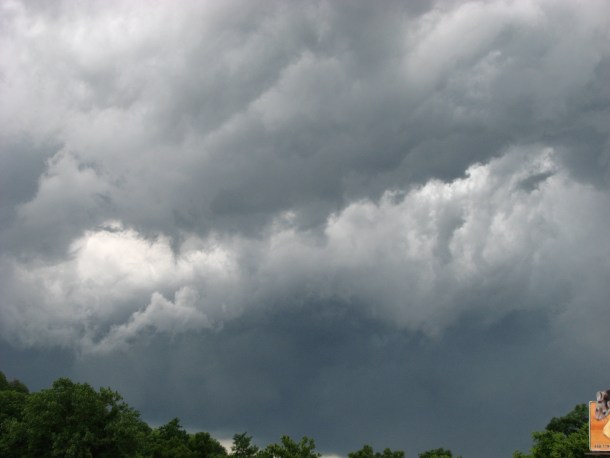
All wacky weather photos by M.B. Henry – for more, check out my sky shots album by clicking here