


Once upon a late night in Gettysburg, Pennsylvania, two college administrators threw in the towel. It had been a long day at Old Dorm – one of the few original buildings on the campus of Gettysburg College. The fourth floor was a busy place, with paperwork to file, admissions to check, and records to store. It made for a lot of work, and the women found it easier after the students left for the day. So, they clocked some overtime in exchange for the peace and quiet. However, quitting time had long-since arrived, and now they headed for the elevator.

Let’s set the mood before their bizarre tail unfolds. The corridors were probably dark. The few lights left on flickered with a quiet hum. The women, chatting and happy to be going home, stepped into the elevator. One pressed the button for the first floor. With a jolt, the box began its slow, creaking descent.
Things turned fishy when the elevator sailed right past the first floor. The two women exchanged confused glances. One punched the first-floor button again to force the elevator’s mechanical hand. The machine clunked to a stop in the basement, a dank room used for storage of old file cabinets and moldy cardboard boxes. Stacks of dusty paperwork. Maybe some leftover odds and ends from when the building served as a dormitory.
The ladies weren’t sure what the hell had happened with the elevator, and they also weren’t prepared for the nightmare that came next.


The elevator door slid open with a ding. Instead of a musty basement, the women observed a scene straight out of hell. Gory, limbless, and grisly men in Civil War uniforms lay on every inch of floor space – crammed in like sardines. They cried in pain and moaned with oncoming death. Their skin had turned white with blood loss and shock. Some were slate and stiff with death. Blood coated all the walls and pooled on the floor, smearing every stitch of clothing.
A haggard crew of Civil War medical personnel oversaw the hideous scene. Worn-out doctors, a few blood-spattered nurses, and military orderlies. They worked with goo-covered bone saws that claimed way too many limbs. Even now, they held a squirming patient down and went to work on a leg. The saw crunched through human skin and bone. Back and forth, back and forth, blood squirting, the man screaming. Nearby, another orderly carried an armful of the bone saw’s harvest – bodiless legs and arms with raw-meat stumps on the ends.
We can only imagine the horror of those two poor administrators. They screamed and cried. They jumped back in the elevator to get as far away from the spectacle as possible. They punched the buttons over and over, praying for deliverance from this horrible slip in time.
One of the medical orderlies of long ago suddenly turned to the elevator. He gazed at the visitors from a different and much safer time. A hollow, pleading gaze that cried for help, any help, with the horrible nightmare of his own era. He walked towards them. He reached out his arms….
…The elevator doors finally squeaked shut and carried the administrators to the first floor. When they got there, everything had returned to normal, except the poor women. Scared half to death (and who wouldn’t be?) they immediately reported the incident to the security office on the first floor. The officer on duty, in a later interview, recalled how shook up the women were. He personally escorted them back to the elevator. Under their terrified gaze, he pressed the button for the basement. When the door slid open, he found…. Nothing. The room was just the lazy old basement it always was.


What. A. Story. I can’t even imagine taking an elevator ride and winding up in the middle of a battlefield hospital, one that operated a century-and-a-half before my own time. This incident, referred to as a “time slip” or “time warp” in supernatural lore, must have been horrifying. However, the two administrators, fighting untold amounts of emotional turmoil, kept their positions at the college. Although they never took the elevator again. Even when they were exhausted, and even from the fourth floor, they remained ever devoted to the stairs.
Their ghostly tale isn’t the only one to emerge from Pennsylvania Hall. Strange goings-on have been reported there for decades. Author Mark Nesbitt interviewed a completely separate woman who had a similar experience with the building’s ornery elevator. Misty soldiers in gray uniforms have been spotted pacing back and forth in the cupola. Shadowy figures have been seen lurking in the tower. One student said he saw a phantom man in the building’s cupola who waved his arms frantically, as if asking for help. When the student called his roommate to observe the man, the apparition vanished. Many others have reported strange feelings of dread and uneasiness when they walk by Old Dorm, as if unseen eyes watch their every move.


So… what the hell is going on at Pennsylvania hall? We know the building is an original structure of the school, called “Pennsylvania College” back then. It first sprung up in 1837, and it was one of the largest buildings on the campus. It provided dorms for students coming from far and wide to study. By the time the Civil War broke out, Pennsylvania Hall had been called home to countless people over the years.
During those fateful days in July of 1863, when all of Gettysburg got torn apart, Pennsylvania Hall transformed into a makeshift hospital – one of many set up under the frantic circumstances. Hundreds of shattered soldiers, in both blue and gray, got dragged into the hallways of the once-quiet dormitory. Dying men bled on the floor. They screamed for help and for their mothers. For relief of any kind. Doctors and nurses rolled up their sleeves, tied on their aprons, and tried to keep up with the influx.
If you ask me, it’s no wonder those ghostly doctors at Pennsylvania Hall are begging for help. Because medical units were pretty overlooked back then, as they are when we study military history today. They shouldn’t be, either. Some of the best contributions to medicine have been made during the heat of wartime, by medical personnel who can think of only one thing – saving more lives. So they put themselves in the line of fire. They work ungodly hours, putting their patients above everything else, rising to the challenge to put bodies back together when war insists on tearing them apart.

Civil War doctors especially had a hell of a challenge. Because it was a curious time in warfare when one side hadn’t caught up to the other. War had begun its shift into the modern area, but medicine remained trapped in the Middle Ages. Surgical and medical kits contained primitive, lanky tools that looked like something out of a murder movie. Mystery concoctions of alcohol and questionable herbs served as medicines. No treatment existed for things like shock, because it wasn’t the least bit understood. Blood transfusions didn’t exist either. Ambulance services comprised of rickety carts that piled as many men in that would fit. Words like “bacteria” and “sepsis” hadn’t quite made it into the medical vernacular. That’s extra scary in a time when the only real treatment for wounded ligaments was to cut them off.
Civil War Surgical wards became infamous for the mountains of blood-soaked arms and legs stacked up outside, as well as for unsanitary filth. The same bone saw got used on dozens of patients before the surgeons would wash it. Instruments for prodding wounds didn’t get sanitized, nor did the operating rooms or the rest of the hospital. Chloroform or whiskey provided the only pain relief for hasty operations, and some soldiers didn’t even have that. Many died from the trauma and the blood loss. As for those with gut shots, doctors usually deemed them hopeless and left them to die. Because if it couldn’t be cut off, it couldn’t be treated. In short, Civil War doctors didn’t stand a chance against the mechanized killing dispensed from artillery guns, repeaters, and rifles.
This made Civil War hospitals almost more harrowing than the battlefields. Many soldiers avoided them outright. One eye-witness to the sorry state of medical care was Louisa May Alcott. Destined to become a very famous writer, she first penned a memoir about her time as a nurse in the Civil War. “I spent my shining hours washing faces, serving rations, giving medicine, and sitting in a very hard chair, with pneumonia on one side, diphtheria on the other, five typhoids on the opposite, and a dozen dilapidated patriots, hopping, lying, and lounging about… who suffered untold agonies.”
Another medical worker, Union surgeon W.W. Keen, doesn’t paint a much prettier picture. “We operated in old blood-stained and often pus-stained coats [with] undisinfected hands… We used undisinfected instruments from undisinfected plush-lined cases and had been only washed in tap water.”


Yikes. That sort of trauma would undoubtedly leave a stamp on the timeline. So many people who could have lived if medicine was just a pinch more up to speed. Although, the Civil War did spawn some major action on the battlefield of modern medicine. It saw the creation of the first organized ambulance and medical units for the United States armies. Nurse Clara Barton, the famed “angel of the battlefield,” put together countless supply drives, some financed from her own pocket, to get clean supplies and medicines to the hospitals. She also went on to form the first American branch of the Red Cross. No less heroic were the efforts of Doretha Dix. In addition to her outstanding services as a nurse in the Civil War, she also brought badly needed attention to the complications of mental illness, and her efforts brought forth some of the first mental hospitals.
The foresight of these people and many others was astounding, especially in such a terrible time. However, medicine still couldn’t quite catch up. Thousands of soldiers died for the sheer want of better medical treatment. Artillery and guns did a lot of damage on the Civil War, but disease earned the distinction of the war’s biggest killer. From the well-over half a million men that died in the fighting, disease killed twice as many as bullets.


It’s tragic that killing and war saw advancement before healing and medicine. Which brings us back to Pennsylvania Hall. Maybe that’s the injustice those ghosts are trying to right when they take unwitting people on elevator rides to the past. There are some ladies out there who might think so, even if most write them off as crazy. Ghosts aren’t real, many would say. Neither are time slips. Stories like that don’t belong in an academic conversation.
I might have to disagree though. I think there’s a lot about this world (and others!) that we don’t quite understand yet. Just like there was a lot about medicine they didn’t understand in the past. I also think those “misses” leave emotional markers on the trail of history – haunted spots that remind us of things we shouldn’t repeat or overlooked stories. People and places that should never be forgotten. It’s an important part of the conversation too, especially when it comes to history. Besides, those doctors and nurses deserve some extra recognition. If ghost stories are what it takes to get it out there, I’ll share them until the end of time.


SOURCES
Gettysburg National Military Park
Civil War Ghost Stories – A. Konstam
Ghosts of Gettysburg/Civil War Ghost Trails – M. Nesbitt
Spirits of the Civil War – T. Taylor
Hospital Sketches – L.M. Alcott
The Civil War: A Visual History – Smithsonian
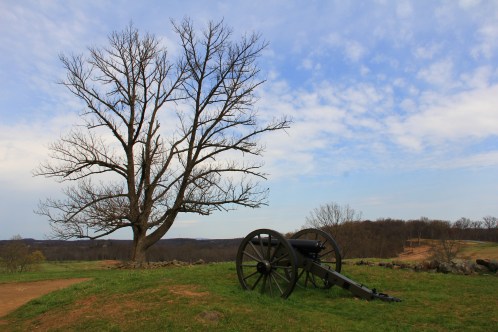
All photos by M.B. Henry (sorry I don’t have one of Pennsylvania Hall! Next time!) For more from Gettysburg, click here.
A very Happy Halloween to all my readers! I wish you lots of tricks, treats, and creepy ghost stories!